
Neue Aktivität

P tenuifolium is hardier here than P tobira too. The former is commonly seen. The latter only in coastal and mild areas. The RHS hardiness ratings for the two species confirm this.

UpperBayGardener, we are I suppose in the foothills of and considerably influenced by The Pyrenees, but not actually in them. They certainly send massive thunderstorms and torrential summer rain our way and it can get very steamy sometimes. Giant hailstones are not unknown in summer too. Our provincial city capital is Girona and I’m in a fairly lush volcanic area to the NW of it called ”La Garrotxa’. Spain has a surprisingly wide diversity of climates for a country not quite the size of Texas. We are category Cfa (humid subtropical) according to the Köppen classification. So is Girona, but we are definitely hotter and more humid here than there, demonstrating considerable variation within Cfa depending on altitude, topography etc.
Our olives do fruit every now and then, but they are old ornamental specimens rather than productive trees. Intriguing that it’s the reverse for you than it is in Europe re pittosporum species.
Thanks Floral, I hadn’t read the RHS info, just going on experiene of what dies and what does not!
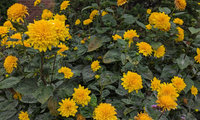
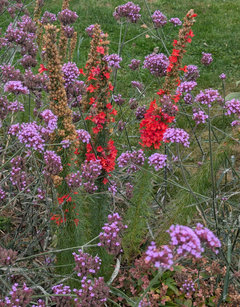
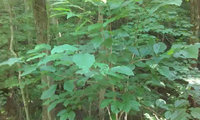
I’m going with paw paw

Leaves edges have smooth margins.
Leaves are around 6-8 inches long in the specimen here, but sometimes larger.
PS: L Clark, that would be some awesome paw-paw to get up into a forest canopy!
Ding, ding, ding. Artinnature gets it first. The parent of the sapling is low down along the road, and here's another just up the slope next to neighbor's driveway. As can be seen, it's a canopy tree.
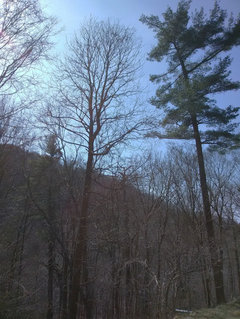
PS: I'd be tempted to transplant the sapling nearer to or on my lot, but it's on too steep a slope, leading down from the road's edge.
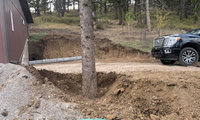

The excavated soil should be as large as the tree's drip line.
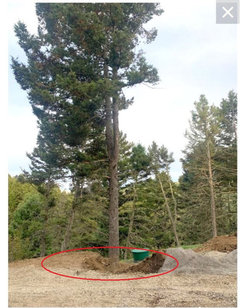

I'd email your local extension service. My parents had wells for the big oaks in their front yard. The wells are all filled and the trees are fine. You may find filling gradually will be okay, which would mean a less permanent retaining structure.

And the extension service - as well as all other reputable sources - will tell you that layering even a small amount of soil (more than an inch or two) over the entire root system can deprive the tree roots of oxygen and smother them, leading to eventual death. I would research this carefully and be cautious about how you proceed.

There would be absolutely no commercial reason to do it specifically on that species as rootstock.
Therefore, you're not going to find it as a 'feature'. If someone isn't grafting onto A. firma for root rot resistance, my understanding is that the leading firs are whatever is easily available to them as seed, which means Nordmann or Balsam fir in the east, A. concolor or other western firs in the PNW. The general paucity of fir cultivars in old municipal collections south of say, NYC, suggests that until A. firma grafting became a thing, a lot of cultivars were grafted onto PNW-native coastal firs and those rootstocks did poorly in the eastern US. For example Longwood Gardens has various seed-grown, own-root fir trees, but very few fir cultivars...even though if you'd opened a 1980s Greer Garden catalog, you would have seen plenty of variegated, dwarf, or whatever, fir cultivars were commercially available. I think back then, very few people thought of the suitability of the rootstock in regions outwith the wholesaler's region.
So, for example, IIRC 'Gee Farms' in Michigan told me on the phone 15 or more years ago that they sometimes grafted onto Balsam Fir, sometimes Nordmann...probably because that's what they had plentiful seed of. I don't even know if that nursery is still around.
While this thread is around...going to pin something tangential here.
I had a grafted Abies vejarii die in the August wet spell. It wasn't even in a very poorly draining spot. By contrast another cultivar that is in a much wetter spot, was fine...implying that one really IS grafted onto firma. (and 3 others in different spots have been fine for years now, I also think they were correctly grafted)
I'm not super upset because honestly, other than the exotic cachet of coming from Mexico, i wasn't really likely the look of the fir's foliage at least. Maybe it would have formed a beautiful tree, but the foliage was that odd olive drab color between glaucous and green. I'd rather have a fir that is one or the other.
I mentioned already that I'd spotted another grafted 'on firma' fir, still in a pot, had fragrant rootstock foliage, meaning it definitely wasn't firma. If I'm being very charitable, I suppose this could happen 'by accident', though there's really no excuse, given that firma is the only fir with no foliar odor! Just check the supposely firma rootstock seeding. If it has fragrance - don't use it! Easy test! Sorry to sound cynical, but this would just be another example of the PNW nursery cabal semi-purposefully ripping off eastern gardeners. (I do start to see more catalogs outright state when something needs a maritime climate, which is a step in the right direction.) I'm not going to name the specific nursery that either plant came from, this isn't an exercise in public shaming. It's an exercise in, 'be careful'.
The best lead for stuff like that would have come from San Marcos growers. Their website is still up, which is a nice gesture; since they DON'T list it, I would suggest it was and is incredibly uncommon in CA.
So your next hope is that nursery in a valley near Ventura that specializes in AU plants. Their name escapes me RN. I've emailed the proprietress many years ago (around my 2011 x-country trip, she wasn't there the day I was coming through, but clearly would have accomodated a visit if possible) and she seems like a nice person. She'd be able to tell you if it's available.

@UpperBayGardener (zone 7) That's a great lead. I will try to talk to the nursery owner. It looks like they stock very few plants, but maybe I can talk her into doing an experiment with this.
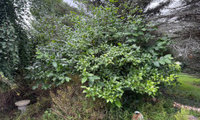
I asked Google AI and it thinks that it’s both the same plant. It thinks the large leaves are “shade leaves“ and the small leaves are its regular leaves that are in the sun.
maackia - I've never seen the tree in Portland or discussed it with local gardeners. Cistus says it should be no problem here, but of course they would. Since my tree is growing for the second time now in September, I would say its probably a pretty quick grower. Probably 25' in gardens, 80 plus feet in native range.
While giving a tour of "Rancho Cistus" earlier this year, Sean Hogan said "we're very lucky to live in a place where anything will grow, whether it likes water or not. For those types that need regular water, just add it and stand back!".
"we're very lucky to live in a place where anything will grow, whether it likes water or not. For those types that need regular water, just add it and stand back!".
I'd have to agree with that :)) A fellow horticulturist once told me the reason his plants grew so fast and so large is that he gave them plenty of water. I've experienced similar - water lavishly (with decent drainage) and plants will grow rapidly and lushly.
btw, I have never heard of Machilus thunbergii although I've a passion for less common BLE's. Everyday I discover more about plants and gardening........ even after all these many years.
I researched Machilus thunbergii in the past, since I was interested in broadleaf evergreen trees that could grow in the Pacific Northwest (climate zone 8 ).
It is actually native to Japan. But in Japan, it is sort of seen as an "inferior" version of camphor tree. However, Machilus thunbergii is more cold tolerant than camphor tree, and can grow in colder parts of Japan; although the majority of the population in Japan (such as in Tokyo) lives in areas where camphor trees can grow.
The foliage of Machilus thunbergii reminds one a little bit of some Chinese evergreen magnolia trees (which are rare in cultivation, but not completely unheard of in the U.S.)
There is also "Japanese cinnamon" tree (Cinnamomum tenuifolium) for anyone who is interested (though it is a smaller tree, and evergreen leaves not as pretty).

Finally went back to the location mentioned above, only to find that the tree had been removed entirely - I'm assuming the homeowner decided he didn't want to live with the root issue long-term.
So I checked another location in a different neighborhood with a Shawnee Brave about the same size/age. The soil in this other neighborhood is well drained. There were quite a few root growths protruding from the turf (which I assume are "knees" beginning to form) that are being suppressed by frequent mowings. Here are some of them:
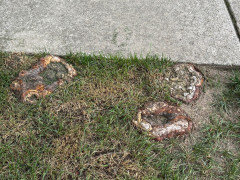
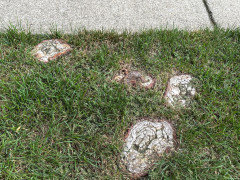
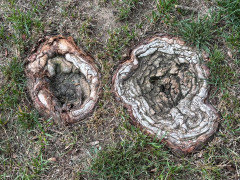
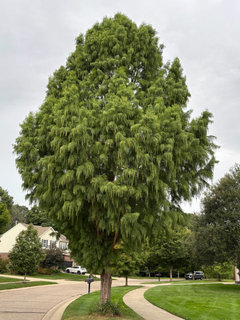
Thanks for the info, arbordave. Looks like the tendency for knees can be unpredictable for baldcypresses in drier soils, but prb'ly a given in a wet/poorly-drained site (like mine). And mowing over those hard knees can't be a good thing for mower blades.
PS That baldcypress you show above is quite elegant.
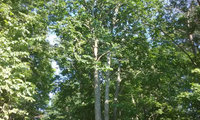
Ding. Ding. arbordave gets it. The forests around here were logged maybe 60 yrs ago, and every basswood resprouted with at least 2 to sometimes 4 trunks. One just across my border stream died for some reason when I was first here, but 22 yrs later there are 4 slender sprouts from its base in rather deep shade that are now 50 ft tall. I posted a pic here some time ago of the dead original trunk that had been ravaged by a piliated woodpecker.
PS The one pictured above has 3 trunks, a shaded one just off to the right.
Hurricane (downgraded on land) from the Pacific is crossing Mexico into New Mexico/north Texas and will bring rain eventually to the mid-Atlantic and northeast. This is much-needed rain for those southwest areas.
We picked up another 3/4" rain night before last.
More predicted tomorrow AM.
It's keeping the soil 'consistently moist' for a change.
Cooler temps now as I mentioned earlier but it did hit 74d and sunny yesterday.
If you hit the box showing the
number of comments it will jump to the bottom.
tj